
Reviewed · HANOI TOURS
Hanoi Knife-Making Class:Join the Legacy in Blacksmith’s Workshop
In Da Sy, a village known for generations of blade-making, you don’t just watch a blacksmith at work: you help turn a piece of metal into a knife of your own. The forge, hammer and grindstone make this a very different sort of Hanoi activity, with a practical souvenir at the end.
I like two things in particular: you learn beside Tuyen, a female artisan who has spent 44 years preserving the trade, and you take part in the work rather than simply observing it. The class also introduces a rare tar-based sharpening technique passed through her family.
One consideration: this is an active workshop, not a relaxed demonstration. You’ll work with heated metal and tools under guidance, and you should check your home country’s rules before carrying a knife on your flight.
- A real village craft: Da Sy has a centuries-old forging tradition and once supplied weapons during Vietnam’s wars.
- A rare female-led forge: Artisan Tuyen has devoted 44 years to the craft and is officially recognized in the trade.
- A knife made by you: Choose a design, forge and shape the blade, and take part in sharpening it.
- A family sharpening method: The final stages include a distinctive tar-based wash.
- Small-group instruction: The class has a maximum of 10 participants, with tools and safety equipment supplied.
- A useful keepsake: Your finished knife is intended to go home with you, subject to your own country’s transport rules.
Da Sy’s blade-making tradition
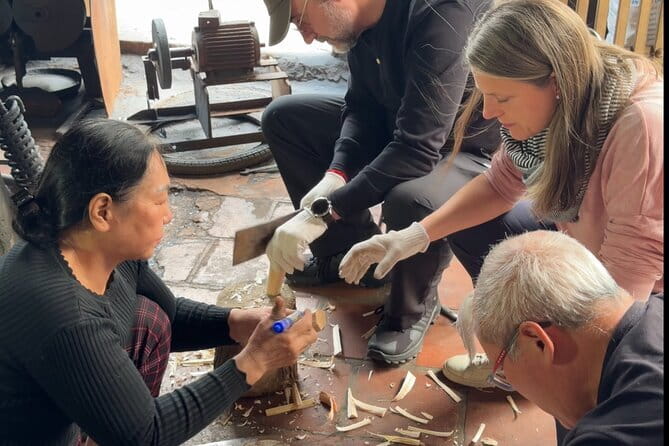
Da Sy is a blacksmithing village in Hà Đông, within Hanoi. Its history is closely tied to the making of blades, and the village once supplied weapons during Vietnam’s historical wars. That background gives this class a stronger sense of place than a generic craft workshop: the work you try here belongs to a local tradition, rather than being a craft imported for tourists.
The class takes place at an artisan’s house, in a working workshop equipped with the tools needed for knife-making. It is a close-up way to meet a tradition that can be hard to appreciate from a finished knife on a market stall. You see the metal at different stages and learn how design, heat, force and careful sharpening all contribute to the final tool.
The central figure is Tuyen, the female artisan identified with the workshop. She has spent 44 years preserving the craft and is described as the only officially recognized female artisan in the trade. That makes the class more than a chance to make a souvenir. You get time with someone whose skill has been built over decades, while the guided format helps turn her knowledge into steps a beginner can follow.
Guides mentioned in connection with the experience include Mint, Nick and Tulip. The guide helps explain the process and bridge the language gap, while the artisan leads the work. Names and assignments may vary, so treat those as examples rather than a promise of a particular guide.
Start with a blade design
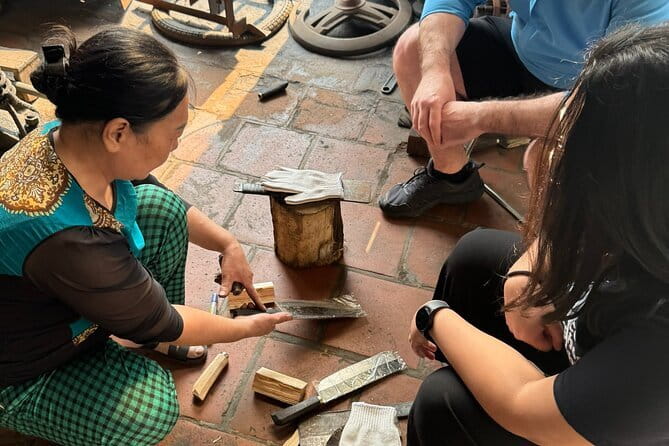
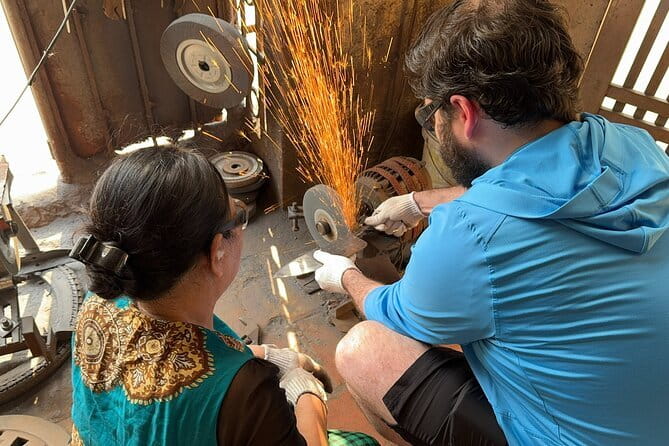
The first step is to choose and sketch the knife design on a selected piece of durable metal. This is where you decide what your finished knife should look like, within the options the artisan can safely help you make. The design matters because it shapes the work that follows: you are not simply receiving a standard blade with your name attached.
The process includes cutting out both the blade and the tang, the part that fits into the handle. This makes the class a genuine sequence of making, not just a quick turn at the anvil. You’ll start to understand how the blade and handle connect, and why a knife is more than a piece of sharpened steel.
The personal choices continue with the handle. The finished knife can be customized, and participants have described starting with a block of wood that still has bark on it, then carving the handle as part of the process. The precise materials and options can depend on what is available in the workshop, but the opportunity to shape your own knife is central to the experience.
More hands-on workshops in Hanoi:
- Hanoi Cooking Class: Culture, Local Market & Meaning CSR Impact
★ 5.0 · 5,147 reviews - 5 Traditional Dishes Hanoi Cooking Class with Market Trip
★ 5.0 · 4,890 reviews - Hanoi Coffee Workshop: Taste Salt, Coconut and Egg Coffee
★ 5.0 · 1,286 reviews
At the forge and the anvil
Once the blade and tang are cut, the metal is heated in the forge to prepare it for shaping. You’ll work with traditional tools such as a hammer and anvil, taking turns striking the metal with the artisan’s help. This is the part many people picture when they think of blacksmithing, and it is also where the class becomes physical.
Expect to take direction, watch closely and make repeated adjustments. Forging a blade is not a matter of giving the metal one dramatic whack and calling it done. You need control and patience, and the artisan is there to guide beginners through the steps. A hydraulic machine helps refine rough edges, so the process combines hand work with equipment that makes the shaping more precise.
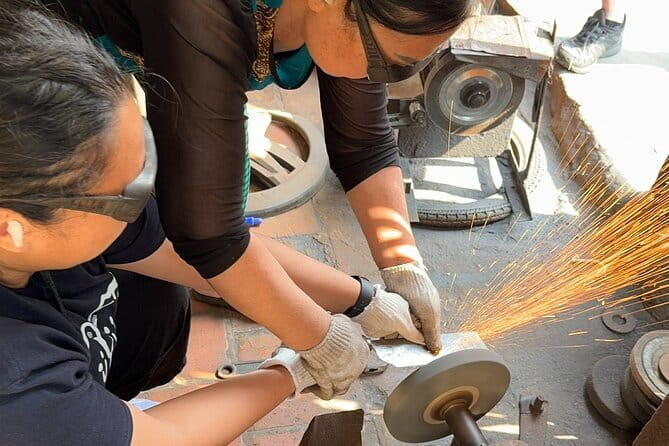
The workshop provides all tools and necessary safety equipment. That is useful for visitors who arrive without any specialist gear, but it does not make this a hands-off activity. Follow the artisan’s instructions carefully, especially around the heated metal and machinery. The class is designed for most people to participate, but it suits you best if you’re comfortable being active and attentive for the full session.
Grinding, sharpening and the tar-based wash
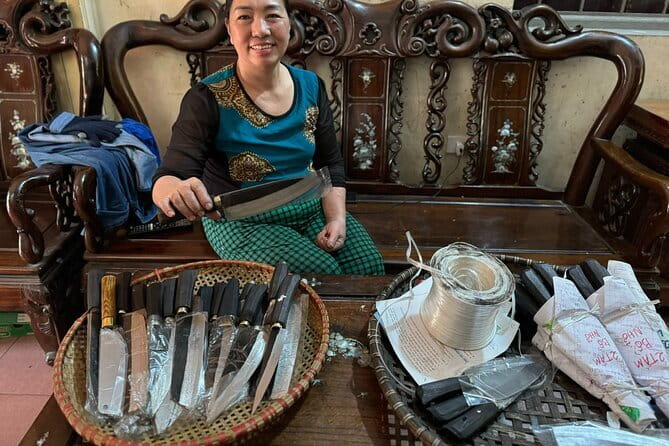
After shaping comes the grindstone. You’ll work on refining the blade and sharpening its edge, an important reminder that a knife’s usefulness depends on more than its outline. The steps require care, and the artisan guides you through them so the finished blade reflects your own work without leaving you to guess at the technique.
One especially distinctive detail is the tar-based wash used during the sharpening process. It is described as an old family method passed down through generations. Rather than presenting it as a bit of workshop theatre, the class places it within the practical finishing of the blade. You get a glimpse of how a family technique can remain part of a working craft.
The class also includes honing and polishing stages, along with carving the handle. The process is hands-on from design through finishing, though the artisan’s help is essential. You are making a knife with expert guidance, not being asked to match the speed or skill of a master blacksmith.
A two-and-a-half-hour workshop, not a quick demo
The experience lasts about 2 hours and 30 minutes. That gives you time to move through several stages of knife-making, from the initial design to sharpening, rather than just trying one task before the group moves on. The duration is a good fit if you want a substantial activity without giving up an entire day in Hanoi.
The maximum group size is 10. A small group matters here because the work involves tools and individual guidance. It should also give you a better chance to ask questions and get help as you make progress, though the pace will still depend on the group and the steps involved.
The meeting point is Đa Sỹ, Kiến Hưng, Hà Đông, Hanoi, and the activity ends back at the same place. The stated inclusions cover the tools and safety equipment, not transportation. Plan how you’ll reach the village before you set out, and confirm any pickup arrangements directly if you need them. Some people have booked a private class with a car, but that should not be assumed as part of the standard price.
More tours and experiences in Hanoi:
- Hanoi Jeep Tour: Food, Culture and Fun by Vietnam Army Jeep
★ 5.0 · 15,222 reviews - Full-Day Ninh Binh Highlights Tour from Hanoi
★ 5.0 · 7,761 reviews - Hanoi: Ha Long Bay Day Cruise – Swimming, Meal, Kayaking
★ 4.7 · 7,415 reviews - Hanoi: Water Puppet Show Tickets
★ 4.6 · 7,029 reviews
Is $45.51 good value?
At $45.51 per person, the price is reasonable if you want an activity that gives you both a hands-on skill lesson and a finished object. The workshop supplies the tools and safety gear, and you take part in making a knife that can be used at home. The value is not just the amount of time spent hammering metal. It also comes from working with an experienced artisan in a village with a long connection to the craft.
This is a better fit for someone who values an unusual, personal souvenir than for someone seeking the cheapest way to buy a knife. You’ll spend 2.5 hours on the process, and the final result carries the marks of your own design and work. If you prefer a polished, low-effort outing, the price may feel less compelling. This is an active class, and its appeal depends on wanting to make something.
Gratuities are optional and not included. You do not need to bring tools, but do allow time and attention for the full workshop. If you are booking with another person, note that one participant has booked a single ticket because they wanted to make only one knife. Ask the provider how the price and participation work for your group if you do not each want to make a blade.
Who will get the most from this class?
I’d point craft-minded visitors toward this workshop first. If you enjoy learning how everyday objects are made, the progression from sketch to sharpened blade offers a satisfying look at design and technique. It also suits people who have already seen Hanoi’s main sights and want a local activity that involves doing rather than just looking.
It can work for a wide range of participants: the activity information says most people can take part, and service animals are allowed. Still, you should consider your own comfort with hot metal, hammering and workshop tools. The artisan provides guidance, but the experience is not described as a passive demonstration.
Families and groups should weigh the same point. A maximum of 10 people keeps the class relatively small, but the work requires focus. If your idea of a good class is relaxed conversation while making something simple, this may feel demanding. If you like practical challenges and don’t mind following instructions closely, the process is part of the fun.
The finished knife is also a memorable keepsake, but it comes with a practical wrinkle: knife rules vary by airline and destination. One participant specifically planned to check home-country airport rules, and you should do the same before booking if you intend to carry the knife home. Don’t assume that because the workshop lets you take it away, your airline or border rules will allow it in your luggage.
A few practical points before you book
The booking confirmation is provided at the time of booking, and the ticket is mobile. The activity is near public transportation, though the meeting point is in Da Sy, so check the route and timing that work for you. Since the class returns to its starting point, you can plan around the same location for both arrival and departure.
Free cancellation is available up to 24 hours before the experience start time for a full refund. Cancellations made less than 24 hours ahead are not refunded, and changes within that same window are not accepted. The cut-off follows local time.
Most of all, make your decision based on what you want to do with your time in Hanoi. This class rewards curiosity, patience and a willingness to use your hands. It offers a tangible way to meet a traditional craft, but the workshop’s tools and heated metal mean you should arrive ready to listen and take care.
Should you book the Da Sy knife-making class?
Book it if you want a hands-on cultural activity, value learning from an experienced artisan, and like the idea of making a functional object from the start. Tuyen’s decades of experience, the small group cap and the chance to try a family sharpening method give this class substance beyond the novelty of taking a knife home.
Skip it if you want a quiet, low-effort class, or if you have no practical way to transport the finished knife under your home-country rules. Before booking, confirm how you will get to Da Sy and check your airline and destination regulations. If those details work for you, $45.51 buys a distinctive 2.5-hour introduction to a village craft, with your own work to show for it.
FAQ
How long is the Hanoi knife-making class?
The activity lasts approximately 2 hours and 30 minutes.
How much does the class cost?
The listed price is $45.51 per person.
Where does the class take place?
It starts at Đa Sỹ, Kiến Hưng, Hà Đông, Hanoi, Vietnam, and ends back at the meeting point.
How many people can join?
The maximum group size is 10 participants.
What parts of knife-making will I try?
You’ll design the blade, cut the blade and tang, help forge and shape the metal, and take part in grinding and sharpening. Handle carving is also part of the process.
Are tools and safety equipment provided?
Yes. Tools and necessary safety equipment are provided at the artisan’s house.
Who leads the class?
The artisan is Tuyen, a female blacksmith with 44 years of experience. Guides named in connection with the class include Mint, Nick and Tulip, though the specific guide may vary.
Can I take my finished knife home?
The experience includes taking home the knife you make. Check your airline and home-country rules before travelling with it.
What is the cancellation policy?
You can cancel at least 24 hours before the start time for a full refund. Cancellations or changes made less than 24 hours in advance are not accepted for a refund or change.
New on the list for Hanoi
- 7 Days Unlimited Data SIM card★ 4.3 · 3 reviews
- Hanoi: All-in-One Walking Tour Through a Train Street★ 4.9 · 65 reviews
- 4-day Motorbike Ha Giang Loop Luxury Tour With Easy Rider★ 4.8 · 90 reviews
- Hanoi: 3-Day Tour to Ban Gioc Waterfall and Ba Be Lake★ 4.9 · 9 reviews
- 3-Day Ninh Binh Bungalow & Ha Long Bay 5 Star Cruise★ 4.7 · 7 reviews
- 3-Day Discover the most stunning Cat Ba Island – Lan Ha Bay★ 4.8 · 6 reviews
- From Hanoi: Ha Long Bay 3-Day 5 Star Cruise with Balcony★ 4.8 · 4 reviews
- 3 Day Hanoi – Ninh Binh – Halong Bay 5 Star Cruise & Balcony★ 4.7 · 83 reviews
Hanoi Tours, compared.

Hanoi Jeep Tour: Food, Culture and Fun by Vietnam Army Jeep
Read our review →
Full-Day Ninh Binh Highlights Tour from Hanoi
Read our review →
Ha Long Bay Day Cruise – Swimming, Meal, Kayaking
Read our review →

Hanoi Motorbike Tour: Food, Culture and Fun by Vintage Motorbike
Read our review →

Hanoi Cooking Class: Culture, Local Market & Meaning CSR Impact
Read our review →
5 Traditional Dishes Hanoi Cooking Class with Market Trip
Read our review →Browse the lists this tour appears in